


SPORTS ROULETTE
Mobile Interface for Sports Wagering
Context: According to Forbes, sports business growth in North America is expected to exceed $100B by 2020. MAX identified that fans are an essential component of the sports industry and proposed this project to conduct research to understand better the Fan Experience (FanX) in sports and then design an innovative prototype solution.
We as team conduct the User Interviews followed by multiple Literature reviews during the research phase. After that, my job was to Define the Business Objective, Design the Concept and Final solution, to solve maximum business objectives.
THE
PROCESS

BUSINESS
OBJECTIVES
-
Fan engagement at live sports events is seen as a critical aspect of sports business for teams and owners.
-
The ability to connect directly with fans via their mobile phones would be an attractive opportunity for sponsors and permit a revenue generation model where products could be developed and provided to fans at no charge. To capitalize on this opportunity, MAX plans to launch a sports-focused product line under the brand XFAN.
MAX retained this project team to help understand sports fan dynamics and iteratively design and test prototypes that can be utilized as a part of XFAN. The level of team diversity and knowledge of sports and current fan technologies in the market helped us to come up with innovative solutions to emerge. The intent is for the solution developed to have the potential to be brought forward as a viable product that XFAN can offer to fans and sponsors.
COMPETITIVE ANALYSIS
We focused our analysis on FanDuel and DraftKings. Our lists of pros and cons for each of these applications are presented below.
FANDUEL
Pros
-
The uniqueness of the ability to choose teams
-
Incentive-based utilizing a ‘gambling’ like system without oversight from the State.
-
No government oversight
-
High risk with High reward
-
Partnerships with the NBA, NFL, and MLB
-
Integrated into the system with influence through advertisements
-
Investment in the community and in the overall system through ads and partnerships
-
The research-based selection process of players on a team, not a game of ‘luck’
-
5.5 Mil users combined with Draftkings
-
Partnered with Google Capital and KKR
-
Development of new product, acquiring new customers and investment in management
-
100% bonus for the first deposit up to $200
-
Provides a lower rank for high stakes games
-
Can handle a large volume of players
-
Salary Cap leagues, or weeklong leagues
-
FanDuel Players Club (incentive to earn more points)
-
Will reimburse your money as a credit if you do not finish first on the first competition
-
Simple to enter the sport, with clear roster setup
-
Lock-in roster allows for one to see the ownership percentage of players immediately
-
Ability to view other opponents lineups before beginning gameplay
-
Operational in the US, Canada, and UK. Plans to add to Germany and Malta
Cons
-
Have become so large they are dealing with PR issues
-
Many politicians are against the App
-
Considered gambling in many communities
-
Can lead to unhealthy habits of spending
-
Underage gambling?
-
Accessibility to youth without proper education
-
Unable to withdraw bonus money immediately
-
Experienced players still prefer a desktop version
-
What can be done to empower more phone usage for in-game settings?

DRAFT KINGS
Pros
-
Ability to earn money without being considered gambling
-
Incentive-based with high earning prizes
-
No government oversight
-
Partnerships with most large Professional sports teams in the US
-
Combined with FanDuel has 5.5 million users
-
416 million in investment funding
-
Fox Sports has an 11% stake
-
Allows for the ability to double first deposit up to $600
-
Offers eSports, MMA, PGA, and NASCAR
-
NFL
-
The higher salary cap for weeklong leagues at 10k more than FanDuel
-
Can play a Flex Player
-
Player pricing based on an algorithm of a matchup, weather, location, past performance, value compared to other players, player popularity
-
-
-
VIP program; those with high gameplay volume gain unique
Cons
-
PR Issues
-
Underage accessibility

FIELD RESEARCH
Observation and Interviews:
In Arena

In order to understand better the professional basketball game environment and spectators, we conducted a field study at Indiana Pacers games at Bankers Life Fieldhouse. For the games we attended, we observed fan activities and interactions while the game was in progress, as well as before and after the game and during breaks in the game.
Direct Observation:
-
In game observation - Stadium
-
Interaction with fans
-
Understanding of game through screens
Informal Interview:
Passive observation was followed up by an informal interview with the user to understand their experience throughout the game. Questions were derived from notes taken during game and general experience.
Reason fans were engaged:
-
Key Events in the game trigger crowd engagement (especially when their team is winning, etc)
-
When they are able to participate in trivia games in between games or during a time-out
-
Intense moments such as when the game score is constantly changing and making it hard to predict which team will win
-
When they can share the game experience on social media (Ex: Sharing game highlight on Snapchat)
Reason fans were not engaged in the game:
-
They get distracted by their phone (incoming text, games, taking selfies, etc)
-
Engaging with other sport while they are at the game (fantasy sports games, etc)
-
Their seat is too far from the court and also the screen (depending on where they sat in the stadium, fans experience can vary)
User pain points In-Stadium Experience
-
Late on capturing a picture or ‘snap’ when an exciting play takes place
-
Inability to participate in prizes unless their seat is chosen, however, wish they could engage in the trivia.
-
Trouble finding multiple seat’s together, unless ordered together
-
Difficulty in finding a parking space
-
Don’t want to miss any part of the game, but are hungry/thirsty
-
Worry about traffic getting back home in a reasonable time, may leave early if a game isn’t going their ‘team’s’ way
User Needs
-
An easy and quick way of finding and buy multiple seats together.
-
Nearby parking alternatives.
-
Get navigation information for available parking spots, seats, food & drinks.
-
Avoid traffic congestion during exit.
-
Shots of iconic moments in the game.
-
Simple and fluid way of participating in break time contest while not discouraged by chances.
LITERATURE
REVIEW

Conducting a literature review helped us understand the different approaches that previous research and studies have found to increase sports attendance and fan engagement in sports games environment. We also learned about existing applications that support fan engagement, as well as sponsorships and funds in a sports environment.
The academic literature on the fan engagement aspects of sports is vast. At every stage of the project, updated literature reviews were conducted to support the agile design and build process that was adopted. Below is a summary of the seminal articles discovered throughout the project.
Research Insights
There was one article discussed how sports clubs and organizations in Europe are approaching their fan to increase fan engagement. The article suggested treating sports fans as "valuable guests" of your brand who are emotionally connected to the sport, club, and the team, instead of customers or consumers. It highlights the significance of gathering data,( before even knowing what to do with it, similar to a team of Olympic Gold medalists Laura Trott and Jason Kenny) to better understand the fans, or supporters' preferences and behaviors to connect with them. The articles provided a matrix produced by David Fowler and Geoff Wilson that is used to manage fan engagement on and off-site and on match days and non-match days. The article also emphasized collecting data as the major step, followed by understanding and using that data. They provided examples of what current clubs are doing for fan engagement on and off the field, and non-match days and non-match days. A few of the example include:
-
The Open (golf): Ordering food from your seat (using mobile devices)
-
Minnesota Vikings (NFL): VR sports museum (Old Museum upgraded to interactive and virtual reality (VR) elements that allow fans to virtually compare themselves with their heroes/sports players)
-
Real Madrid (football): Fan app (fans can purchase merchandise, check stats of the sport, or explore deals tailored to the user.)
-
Benfica (football): Emirates “safety video” (on match day, sponsors team with clubs to show safety instruction, where many fans are engaged and capturing/sharing the moment on social media)
-
Tampa Bay Lightning (hockey): “Smart jersey” ( the hockey club/team embedded RFID chip to the season ticket holders' jerseys, where they receive a discount in the club store and the retail stands if they wear the jersey.
-
Atlanta Braves (baseball): Creating memories ( fans can take selfies with their players and share it)
-
Manchester City (football): High-speed wireless internet (the Etihad stadium provide fans with high-speed wireless internet access so that fans can share their experience at the game on social media
-
Tour de France (cycling): Data predictions (using GPS and radio frequency chips attached to each bike, fans who're watching the race on TV can see all aspects of the race.
-
Notre Dame (college basketball): Emotional content (sharing emotional content)
-
AS Roma (football): Fan-designed website (taking suggestions from a fan and catering their need)
-
ECB (cricket): Fan app (allow fans to replay previous games)
Reference: https://other.media/best-in-class-sports-fan-engagement/
Result Analysis:
Based on the field research, we developed two personas. The personas represent some of the fans that we observed during Pacers games.
ANALYSIS OF USERS AND ACTIVITIES
Based on the Field Study (Field Research & observation), we developed a couple of user personas that represent the people that we observed during the field study to help us guide our research and design focus.
PERSONA ONE
In-stadium game experience with family

I'm a huge sports fan so I enjoy watching sports games with my family. But my wife and daughter are always distracted by their phone. I want them to enjoy and engage in the game.

Age: 49
Work: Office Manager
Family: Married, 2 kids
Location: Indianapolis, Indiana
Character: Competitive
Goals:
-
Be able to find the cheap parking space near the stadium and arrive on time for a game
-
Find a coupon which he can use for food or beverages
-
Wants to enjoy the game with family without any distraction
Frustrations:
-
Find parking is difficult and expensive
-
The food at the stadium is expensive
-
His wife and daughter are always on the phone and not paying attention to the game
Bio:
Thomas is working as a manager at a small business firm. Since the company has only one manager, he doesn't have a day off for several weeks. The company recently hired an assistant manager so he's is finally able to take a day off. Since there is a Pacers game on Monday night, which he and his son loves, he decided to spend his day off with his family watching Pacers game and also use it as a family get together. He is frustrated because finding the parking space near the stadium is difficult and the food at the game might be pricey. He also frustrated that his wife and daughter are always getting on their phone(taking pictures, games, and social media). He would like them to enjoy the game but he does know what to do.
PERSONA TWO
In-stadium game experience with friends
I'm not a sports fan but I'm here to just give company to my project partners. My main aim is to just relax so that I can get back to my assignments with a fresh mind.

Age: 21
Work: College student working part-time
Family: Single
Location: Indianapolis, Indiana
Character: Studious
Goals:
-
Understand the game more and how it played
-
Start with a fresh mind so that he can perform well in projects and finals
-
Discover about players and team
Frustrations:
-
The game moves really fast and it's hard to keep up
-
The terms his friends are using, he is not aware of that paying attention to the game
Bio:
Jeremy is a graduate student and working with one of the university professors. He is someone who likes to spend time in the library rather than watching or playing a sports game. He is frustrated because as the semester is coming to an end there will be more projects and test so he needs some break to start with a fresh mind. One of his project partner who is an avid sports fan invited him to the Pacers game. Since he has never watched the single game in stadium Jeremy is excited to watch and enjoy as much as he can.
CONCEPT DESIGN
DESIGN CONCEPT ONE:
FAN ENGAGEMENT DURING DOWNTIME
This design concept allows users to replay game highlights in AR (Augmented Reality) view where they can view the replay from different perspectives. It also allows users to use AR navigation that helps them locate their specific seats, as well as finding food stalls and restrooms.

AR CONCEPT

AR CONCEPT
Key elements:
-
Gamification using AR to compete as teams at the stadium during the breaks.
-
Geolocation beacons to push contextual content to the user.
-
AR in-stadium navigation.
-
AR replay/highlights where the user can pause the replay and manipulate the content in 3D.
This solution addresses multiple user needs and satisfies goals defined during research. The augmented reality game is aimed at controlling the use of mobile phone by gamifying the break duration using an AR game to compete with opposite team fans ins stadium. This promotes user engagement during downtimes while building brand loyalty through rewards from sponsors. This benefits both the user and the sponsor.
The augmented reality replay enabled with 3d manipulation for the user to see a different perspective of the action. The screenshots from this are quick bite-sized content easy to share and consume.
The geolocation of user with multiple beacons across the stadium helps in providing contextual information and advertisement to the user. This also enables us to help the user’s better.
The navigation enabled by augmented reality solves the user's problem of finding the right seat, food stall, and other stadium facilities.
DESIGN CONCEPT TWO: OVERALL STADIUM VISITING EXPERIENCE
This design concept/sketches illustrate the overall experience of the sport user/fan. The main purpose of the concept is to enhance the overall experience of the user including:

-
Locating parking near the arena,
-
Ordering food from their seat,
-
Getting a reminder (cheer chant/tactics to use) for cheering
-
Asking sport related questions from the ask feature,
-
Finding sport buddy who can go to the game with you
-
The last feature allow users to learn more about different sports
Key Elements
-
Convenient Parking Finder for any sports games using a mobile app
-
Ordering food/drinks through the mobile app from the concession stand
-
Any sports-related news and team standings in any sports
-
Communication platform for sports fans (Q & A)
-
Find a Game buddy (other fans) to watch a live game together
-
Learning about other sports
-
Team game or trivia questions/games that test the fans knowledge of their supported team
Design Concept 2 support users needs by goals from the field research/observation that was conducted in stadium, bar, and home. The cheer feature help fans engage in the game by getting a reminder when to cheer and what cheer chant/tactics to use. The food/drink ordering feature also allows fans to order food/drinks from their seat without having to wait in line at concession stands, as well as keeping them from distractions (ex: leaving the game to buy food).
Convenient parking finder feature allows users to find parking near the stadium which saves them time and prevents frustrations caused by parking garage/space availability.
The game buddy feature support users need in finding fans who are also looking for other fans to go to the game together when they don't have anyone to go with.
The Ask or Q & A feature help the sports fans to keep each other updated and to keep in touch by asking each other's opinions about the game that they watch or any other sport-related questions.
The Sports News & Standings feature allows fans to keep updated about sport related news and their team standings. The Sports Ed feature enabled fans to learn about other sports that they’re curious about by providing them short info, how to play, tips, and practice game to get a feel of what the sport is.
The Team Game feature allows fans to get to know their team players better by playing trivia questions/games that test and enhance the fans knowledge of their supported team.
DESIGN CONCEPT
THREE: LIVE ACTION
FAN ENGAGEMENT
The main purpose of this design concept is to keep sport spectators to engaged during live basketball game. Some of the feature included shot prediction. This feature will allow the user to be able to predict the next shot that the player will make from specific spot on the court from the previous games data, which will be available in application. They can wager the in-app currency and if their prediction is right they can get twice as much as they wager initially.

Key Design Elements:
-
Provide an engaging interface for review historical basketball shot data
-
Connects fans with players and teams
-
Time bar feature allows a dynamic view of shot patterns over time
-
Improves Fans ability to predict where the next shot will come from
-
-
Shot prediction interface allows Fans a fast way to make a prediction
-
This enhances fan engagement throughout the entire game
-
Even casual fans are able to make a simple guess
-
-
Selecting the number of points to stake on your selection improves fan excitement levels
-
The calculation of how close your guess is with the actual shot to generate Prize Points will enhance the excitement.
-
Further incentives to risk points each round are generated through an elimination cutoff system. The lowest scoring players are eliminated from the competition.
-
The use of a Fan Cam ensures losing players can still follow along and stay engaged with the system and sponsors have an opportunity to expose their brands in novel and fun ways.
Our research revealed a number of key aspects of fan engagement during live professional basketball games. This concept was developed to address some of these aspects and improve the overall experience of fans in a stadium. Excitement levels of sports crowds are driven by a range of factors but a core element in every game is scoring events. In basketball, scoring events are very frequent and a variety of statistical data is captured and shared in real time. This data includes parameters such as the player making the shot, the time the shot was taken and the coordinates on the court where the shot was taken from. Historical data is available where the shot is taken from and can be combined to provide rich visualizations in the form of zone statistics or heat maps. When this data is presented to fans they can quickly understand shot trends and make predictions
By giving fans a method to stake points on each prediction a competitive dynamic is added to the shot predictions they make. Many games in the NBA have uneven score lines where one team dominates points scored. In these situations, fan excitement levels are much lower and many will actually leave early. This concept combats that negative experience for fans by giving them a way to remain engaged in the action on the court even if their team isn’t winning.
Ideation Selection Process
During the design ideation phase of this project, new ideas were continually generated, explored by the team and iterated upon. Naturally, there were many features that morphed into new concepts or merged with existing concepts.
The Live Action Fan Design (Design Concept 3) was selected because it offered the most flexibility to integrate the best design elements from the other concepts.
TASK FLOW

LOW FIDELITY
PROTOTYPE

-
When user open the application, screen A is the first screen that they’ll see, where they can choose the type of service that they want.
-
If they choose the Prediction & Wager, they can choose the team that they can want to wager on, as well as the date of the game.
SCREEN A

View players data
before making the prediction
View heat map of shots made before prediction
SCREEN C

Cards displaying different games per day (vertical scroll)
Dates can be selected swiping the boxes horizontally
SCREEN B

SCREEN D
Filter for the heatmap to show data for specific game/player/team
After they choose the team that they want to wager on, the next step is to view stats and successful shot history of the team. The Screen C(Box Score) is the statistics of the team and Screen D is the shot history of the team display in a heatform form. These feature allow users to determine where the next shot might come from, thus helping them predict the next shot.

SCREEN E
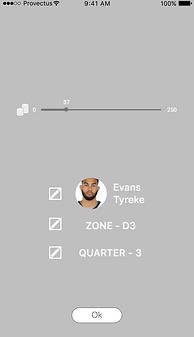
Select the player
for prediction
Indicator on steps left to complete the prediction and wager

Select the zone from where the shot is predicted to be made
The user can then choose and select the player that they want to make a prediction and wager on. Then they can choose the zone of that they think will
SCREEN F
Select the amount of wager
from total available
Lastly, the user can choose the amount of tokens that they want to wager. The users also have the option to edit the player that choose, as well as the zone and the quarter.
Option to edit selected players, zone and quarter
SCREEN G
USER TESTING OF LOW FIDELITY PROTOTYPE
We conducted informal testing with two participants to obtain general sentiment from potential users on the prototype functionality.
The key insights were:
-
Ability to select the location on the court directly from the heatmap screen.
-
Need to show the rewards to motivate the user to play and wager.
-
The navigation within the filter page needs to be intuitive.
Next Design Iteration
After consideration of the User Feedbacks, a rapid new prototype was developed to address these issues (Direct Court Selection, Instant Rewards, Simplifies game, Choose by player or whole team). The significant changes made were also deemed necessary based on specific requirements from the product owner for the ability of sponsors to be able to engage with the fans.
HIGH FIDELITY PROTOTYPE
We fixed the issues our users suggested us during the pilot testing and developed the high-fidelity prototype. The concept of our high-fidelity prototype is related to the roulette concept. Here user has to predict the next shot in order to win.Here we are asking user to select the player they want to go with, for each player we have given the heat map from where user can identify the strenghts of the specific player. After selection of the player user needs to add some chips in the basket, user have to put at least 300 chips so as to lock the bet. Lock bet feature allow the user to place the chips on the areas they want and now they have to wait for actual shot to happen.

Introduction screens to create a username and password for the application. For existing user username and password are require but novice user should enter the full name, user name, password. Here we are also asking user to scan the valid state id so that we can confirm that they are above 18 years old.

Observe your current daily sports news by swiping through the news feed.
Here user has selected the basketball game and the calendar is showing the scheduled basketball games on that day only.
.png)
Use can see the live scores of the on going game. He or she can customize this feature according to their choices.
Here user can select the sports on which they wants to play. Rightnow it shows eight sports but they might increase or decrease according to season.
Calendar shows all the games schedule. Here using this feature user can also see the upcoming games.


First screen shows the top four sponsors we have and if user want to go for other sponsors other than that then can swipe up and see the entire list of sponsors according to categories. The categories which we have given are shopping, food, apparel. User needs to choose the sponsor for which you would like to potentially use your coins towards after gaining points from the gameplay.
%20(11).png)
%20(9).png)
From this screens, the user can select a player from either team in a current game and then place the sponsor chips on one or more areas of the court to predict that the selected player will make the next shot from that area. Selections can be made only during a break in the game. The next made shot after that break determines the winning player/area. Identify which player you would like to play your wager on, and a player from your opponent and place your coin where you believe they are likely to score from.
USER TESTING
PROCEDURE:
We asked the test participants to complete a survey at the conclusion of the usability test. The overall focus of the survey was to gauge how comfortable users felt while using the prototype. Questions were primarily centered on frequency of use, ease of use, and functionality of the website. We used a 1 through 5 scale, with 1 being strongly disagree and 5 being strongly agree, to better accurately rate how the test participants felt.
TEST PROTOCOL
TASK ONE: SIGN INTO APPLICATION
TASK TWO: EXPERIENCE THE HOMEPAGE AND SELECT BASKETBALL GAME TO PLAY ROULETTE
“Assume that you have just downloaded the application and want to start using it. You could create a new account but please use john as user name and iupui as password”
“Congratulations you have reached the main home screen of the Sports Roulette application. This is where you can check your account profile, read the latest news and select a game to play. Please take some time to explore what is available on the screen” (Give the user time to explore the application)
“Now select the Warriors vs Pacers game and proceed to play the Sports Roulette mobile game”
TASK THREE: ENGAGE IN BASKETBALL GAME AND USE THE PROTOTYPE TO PLACE A BET
Step 1: “The game is already underway so please review all the sponsors available and use the prototype to select adidas as the company that will provide clothing as prize options if you become eligible for prizes.”
Step 2: “Although the game has already started there is currently a time out on the court. Review the players then select player #2 from the Pacers, and select player #23 from the Warriors to place a wager on.
Step 3: “Choose player #2 from the Pacers, and player #23 from the Warriors and observe changes as you click through players available.”
Step 4: “There is 30s left in the timeout so now select 600 of the Adidas tokens and lock in your bet for each player place them on the court where you think those players will shoot from next.”
TASK FOUR: COLLECT YOUR PRIZE AND SHARE YOUR RESULTS ON SOCIAL MEDIA
“The game resumes and you watch with your friends as the predictions you made are accurate. Collect your winnings from the game that just finished, and please share your results with friends on social media.”

RESULTS FROM USER TESTING
TASK ONE
Sign in was conducted with high easability and did not not have troubles. Concerns that were drawn from this task seemed to focus on the ability to work through the screen to type in individual names, when they were reminded to use the provided username and password.
-
Future direction may need to focus on the ability to type in individual user names, and then move to the hotspot for an easier testing experience.
TASK THREE
User’s tend to swipe through the user rather than using the arrow provided to reach the next player for selection. This can be improved through redesign of a swipe through function or potentially the use of voice integration (for user’s that know the player they want to play immediately.
TASK TWO
-
Latest news was not directed to the user’s preference, which allows for future design to provide a preference option in the user profile before reaching the home screen.
-
Through guidance of the user tasks, the user was able to complete the task in the given time, with a positive response demonstrating ease of use to reach the basketball game, sponsor page.
TASK FOUR
-
User had wanted to know which prizes would be available, which was not presented in the prototype due to inability to connect with sponsor.
-
The user enjoy’s the fact that they have the ability to rejoin the game and continue playing, to gather up more points for future prize collection.
-
User had expressed that they would like to see the value of points collected on the collection prize screen, to determine if it was worthy to cash in.
-
All user’s enjoy’d the ability to share their results on social, as social media was one aspect that they did not know was existent.
-
This demonstrates the need to show social earlier in the prototype.
-
COMMENTS
-What user’s liked:
-
Ability to “guess” where the next shot may come from
-
Potential ability to play in real-time
-
Learning about players by playing the game
-
Viewing their news feed in the home page
-What user’s felt needed improvement:
-
Data visualization of shot history
-
Understanding the different shot zones
-
More player history and background data on the team’s current status
CONCLUSION
We believe that our prototype provides a good, initial representation of user interactions to predict shot location for basketball games. It also provides an innovative way for sponsors to engage with the user experience of sporting events. Our testing results provided positive feedback, but also indicated issues that need to be addressed.
When conducting user testing, multiple responses indicated the need to go back to the user profile and check their progress. In testing we had assumed the user would utilize the hotspots through our own cognitive walkthrough. This information has provided the need for future direction and the need to provide more activate hotspots. Heuristic evaluations and cognitive walkthroughs after dissecting the user results will provide the necessary information for the final adjustments to have an efficient think aloud test with the user.
This concept was recognized as an innovative approach to live in-play fan engagement. Wagering on shot locations is not a betting market currently offered by any of the major bookmakers. The challenges around the timing of game play and opportunity windows available to place a bet may be a limiting factor for this concept. The technical challenges associated with integrating real world data with a prototype application limited the fidelity of user testing of this aspect of the concept. Further work is needed to enhance the current prototype to a level that would permit such testing.
Our team, in partnership with MAX, plans to continue design iteration and testing to improve simplicity in the user flow. A higher-fidelity prototype would provide for a more realistic user experience that is based on a “live” game.
Changes proposed for the next design iteration include:
● Integrate point history into the user profile screen.
● Develop a user-friendly chip-placement that considers accessibility issues.
● Improve the visibility of the shot clock and time left to place a bet.
POSTER DESIGN

